Migrating a Legacy Monolith to Microservices Using the Strangler Fig Pattern
A financial services platform had been running on a 10-year-old monolithic application that had become increasingly difficult to scale, maintain, and deploy.
Challenges
❌ Long deployment cycles
❌ Growing technical debt
❌ Scaling the entire application for small feature updates
❌ High risk during releases
Our Approach
Instead of rebuilding everything from scratch, we adopted the Strangler Fig Pattern.
The strategy was simple:
✅ Identify bounded business domains
✅ Extract services incrementally
✅ Route traffic gradually to new services
✅ Maintain compatibility with the legacy system
✅ Continuously monitor performance and stability
Technology Stack
- Kubernetes
- Docker
- API Gateway
- Event-Driven Communication
- CI/CD Automation
- Monitoring & Observability
Results
📈 Faster deployment cycles
📈 Improved scalability
📈 Reduced operational risk
📈 Better service isolation
📈 Increased development velocity
Most importantly, the migration was completed with no service disruption for end users.
Key Takeaway
Large-scale modernization projects don't have to be high-risk. With the right architecture strategy and phased execution, organizations can modernize critical systems while continuing to deliver value to customers.
Have you ever migrated a monolith to microservices? What challenges did you face?
Insights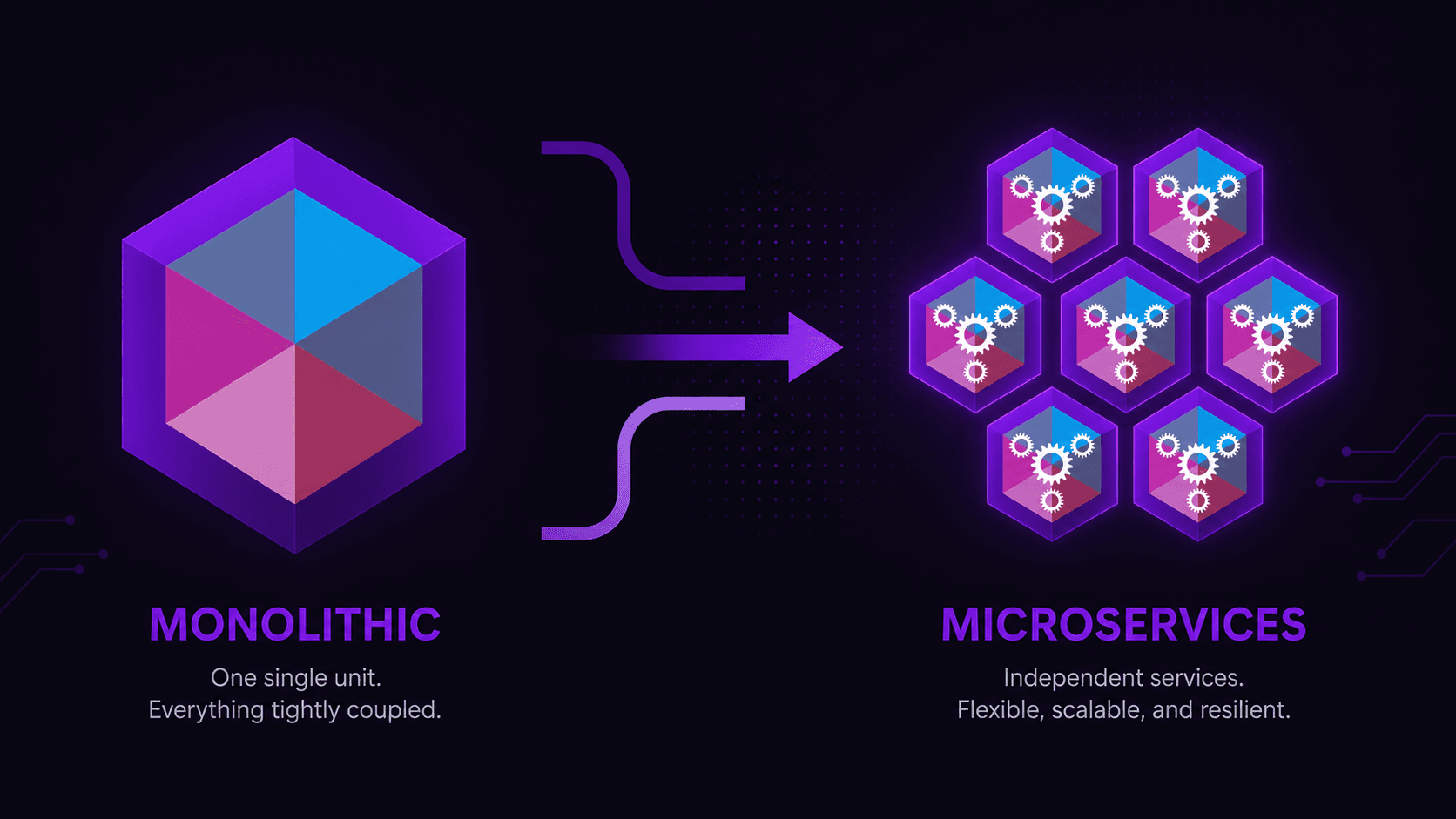
ArchitectureJune 17, 20261 min read
Migrating a Legacy Monolith to Microservices Using the Strangler Fig Pattern
TC
Tushar Chavda
Sr. Full Stack Developer